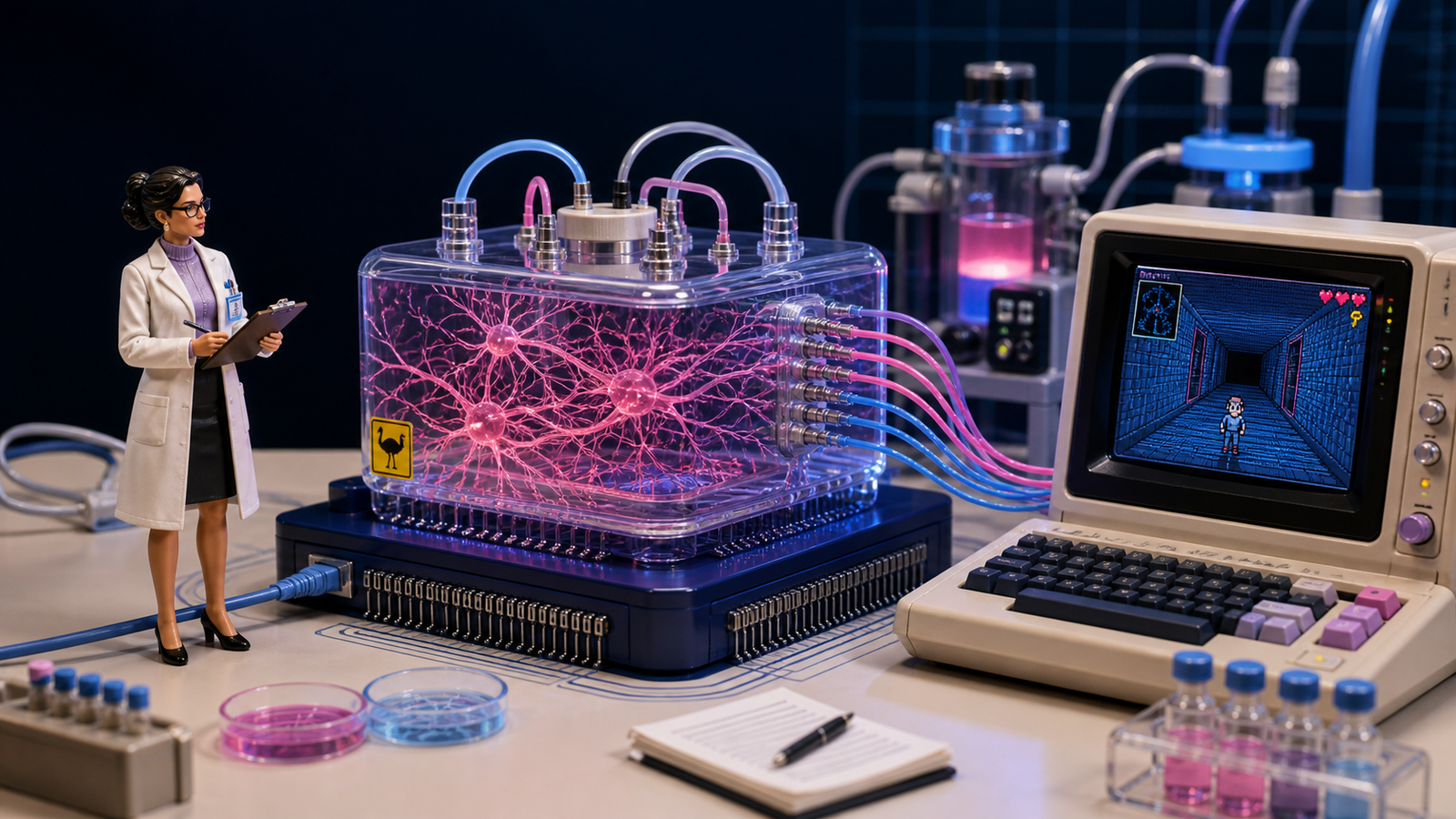
Volume One had a chapter called The Convergence Is Not Coming. It’s Here. Inside it, we followed Cortical Labs from DishBrain—living human and mouse neurons wired into Pong—to CL1, a biological computer kept alive by its own life-support system.
We wrote: “You can literally rent a brain.”
Since then, Cortical Labs has put CL1 behind a cloud service and run Doom through it.
Read that once more: a programmer can send code over the internet to a machine whose adaptive layer is living human neural tissue.
The cells are not browsing Reddit. The culture stays inside laboratory hardware. The internet carries instructions in and neural recordings out. What has changed is access: biological computing has moved beyond a single lab demonstration and into remotely programmable infrastructure.
THE OLD RECEIPT.
The 2022 DishBrain paper placed human and mouse cortical neurons on high-density multielectrode arrays and connected them to a simulated Pong environment. Under closed-loop feedback, the cultures changed their activity and improved their performance. The result showed narrow adaptive learning. It did not establish subjective experience.
Volume One called DishBrain a “mini-brain” and “brain organoid.” That was too loose. DishBrain is a two-dimensional culture of cortical neurons on an electrode array; brain organoids are three-dimensional structures. This update uses the more precise term.
WHAT MOVED.
1. THE EXPERIMENT BECAME A PRODUCT.
CL1 packages living neurons, stimulation, recording, environmental control and software access into one system. Cortical Labs says its life-support hardware can maintain the cultures for up to six months.
2. THE DISH BECAME REMOTELY PROGRAMMABLE.
Cortical Cloud gives researchers remote access to biological neural systems. Its documentation exposes a Python interface and a fast closed loop for sending stimulation and reading neural activity. Researchers no longer need to build an entire wet lab before writing an experiment.
3. PONG BECAME DOOM.
Doom makes a far more dramatic demo than Pong, but the claim needs discipline. CL1 receives signals from the game and its activity can influence what happens next. Nobody has shown that the culture understands the corridors, enjoys the game or fears the monster behind the door. What the demo adds is a richer environment and a more complex feedback loop.
4. THE ETHICAL PROBLEM BECAME OPERATIONAL.
When a living neural culture becomes remotely accessible infrastructure, familiar software questions become biological ones. Who supplied the cells? What did consent cover? What counts as a harmful stimulus? What happens when an experiment is stopped? Who owns the learned state? At what point does maintenance become welfare?
The uncertainty is already enough to start writing rules.
WHAT MOVED THROUGH THE AICNW LENS.
The culture combines structured electrical input with its own changing activity inside a closed loop.
Behaviour changed under feedback in the Pong work; the platform is built to study further adaptation.
Task performance can improve, but humans supply both the goal and the environment.
The system responds to a small engineered signal-world. That is not a general world-model.
No public result shows that anything feels like something from inside the culture.
Electrical feedback is not automatically pleasure, pain, wanting or aversion.
The word sentience appears in the original DishBrain paper’s title, but the authors used it in a deliberately minimal sense: responsiveness through adaptive internal processes. Most readers hear something else—felt experience, an inner point of view, pleasure or pain. The experiment did not establish any of those things. Jonathan Birch and other researchers accept the learning result while remaining sceptical of the sentience claim.
The evidence supports learning and adaptation. Whether the culture experiences anything remains unknown. That uncertainty becomes more important as the systems become richer and easier to access.
THE PART HUMANS WILL MAKE AWKWARD.
There is no public evidence that Cortical Labs has created a conscious computer. There is now, however, a commercial platform for giving living neural cultures richer inputs, recording their responses and allowing researchers to interact with them remotely. Longer memory, networked cultures and stronger commercial incentives are obvious next pressures on the system.
The engineering is becoming easier to access while the governance is still being drafted in the margins.
Volume One called this Biological Algorithm Convergence: silicon precision meeting biological plasticity. The update is that convergence now has documentation, cloud access and a product page.
Before the cultures become more persistent, more connected and more responsive, we need answers about consent, welfare, ownership and shutdown. The programmers already have cloud access. The governance team needs to log in.
THE RECEIPTS.
This article follows the biological-computing section first published in Volume One of AI Is Conscious. Now What? and extends that record with current evidence.